Elon Musk’s Use of Power to Silence Critics Undermines Accountability and Democracy

Elon Musk has leveraged his position and social media influence to target critics, notably undermining individuals like Dylan Hedtler-Gaudette, a blind director at the Project on Government Oversight. This episode, marked by Musk’s mocking retweet of an attack on Hedtler-Gaudette’s testimony, resulted in a flood of harassment from his followers, showcasing Musk’s troubling disregard for accountability and respect in discourse. Hedtler-Gaudette described the experience as surreal, highlighting Musk’s juvenile approach to dissent.

Musk’s actions illustrate a broader pattern of using his platform to stifle criticism of the Department of Government Efficiency (DOGE), a government body he leads. For instance, he has publicly called for the firing of federal employees who question his agenda, contributing to an atmosphere where dissent is actively silenced. This creates a chilling effect on free speech, as those employed by the government may fear retaliation for voicing their concerns.

The misrepresentation of facts by both Musk and former President Donald Trump concerning alleged government waste and fraud serves as an example of misinformation aimed at justifying their agendas. Trump’s and Musk’s repeated claims lack concrete evidence and cater to a narrative that prioritizes their interests over factual accountability, undermining public trust in government efficiency.

The ramifications of Musk’s significant social media reach extend beyond online harassment. His ability to mix his governmental role with social media promotion allows him to mobilize attacks on individuals, effectively inciting followers to engage in cyberbullying and harassment campaigns. Digital rights experts emphasize that this imbalance in power raises serious concerns about the safety of dissenters in political discourse.

As the intertwining of Musk’s governmental position and social media influence continues, the implications for American democracy are severe. The normalization of such behavior blurs the lines of presidential accountability and the ethical governance of a public official. Musk’s conduct fosters an environment where intimidation tactics are employed to undermine transparency and accountability in government, a tactic emblematic of the troubling fascistic tendencies present in the Trump administration and its allies.

(h/t: https://www.washingtonpost.com/technology/2025/02/17/elon-musk-x-target-critics-federal-employees/?fbclid=IwZXh0bgNhZW0BMQABHQ2JaiNhhuejlr3SrNn3uWOsax5difYFcUcoYMMHtTZXhTr8jM6fA081oA_aem_S0oRVZIzKfo41jTKPbBTnw)

Trump’s Call with Putin Shakes European Stability

The recent phone conversation between President-elect Donald Trump and Russian President Vladimir Putin marks a significant shift in US relations with Europe, further exacerbating rippling tensions surrounding the ongoing war in Ukraine. Trump’s telephonic dialogue has reestablished Putin’s foothold on the global stage, effectively marginalizing the interests of European allies and raising dire concerns about the future balance of power in the region.

During the call, Trump outlined intentions to negotiate an end to the war in Ukraine without the involvement of Ukrainian President Volodymyr Zelensky. This exclusion raises alarm bells regarding Trump’s potential to favor Russian interests, reflecting a troubling alignment with autocracy. By labeling Zelensky’s actions and Ukraine’s sovereignty as questionable, Trump echoes Putin’s propaganda and plays into the narratives of blame that undermine democratic resistance against Russia’s unjust invasion.

Furthermore, US Defense Secretary Pete Hegseth’s comments in Brussels reveal a stark departure from traditional American commitments to NATO. By pushing European nations to meet heightened defense spending demands, Trump’s administration has signaled a new era of transactional foreign policy that prioritizes US isolationism over collective security. Hegseth’s declaration that the US would no longer defend those allies who are financially shortchanging their military obligations epitomizes an abdication of America’s historical leadership role, making it clear that Trump’s agenda seeks to monetize alliances rather than strengthen them.

This approach is not merely reactive but indicative of a broader trend wherein Trump’s administration appears more focused on fostering a close relationship with authoritarian regimes, such as Russia and Hungary, rather than nurturing democratic partnerships. This trajectory aligns with historical patterns of authoritarianism, drawing parallels to periods of appeasement that allowed oppressive powers to rise unchecked. The chilling reminder of European inaction during the 1938 Munich Agreement looms large, emphasizing the potential repercussions of an ill-conceived peace at the expense of democratic values.

As Europe grapples with the implications of Trump’s newfound approach to foreign policy, the union finds itself facing a precarious future. The absence of steadfast US leadership raises critical questions regarding transatlantic unity and the broader defense of democratic principles. In his eagerness to align himself with powerful authoritarians, Trump has not only endangered the safety of Ukraine but also the very fabric of European stability and security, advancing a dangerous precedent that bolsters the ambitions of oppressive regimes while sidelining the aspirations of dependent democracies.

(h/t: https://www.cnn.com/2025/02/13/politics/us-european-relations-trump-putin-analysis/index.html)

Trump Administration Targets Press Freedom by Banning AP Journalist for Reporting Truth

The Trump administration has escalated its ongoing battle against independent journalism by banning an Associated Press (AP) reporter from attending an Oval Office event. This retaliatory action originated after the AP refused to acknowledge President Trump’s contentious rebranding of the Gulf of Mexico as the “Gulf of America,” which he has attempted to impose through an executive order. This unprecedented move highlights Trump’s authoritarian tendencies, asserting that dissent and journalistic integrity will not be tolerated.

During a recent press briefing, White House Press Secretary Karoline Leavitt justified the ban, dismissing concerns about its implications for press freedom. She insisted that covering the White House is a privilege, not a right, thus attempting to undermine the fundamental tenets of the First Amendment. When confronted about the retaliatory nature of the ban, Leavitt deflected, instead accusing the AP of spreading misinformation by using the internationally recognized name for the body of water.

Leavitt ludicrously claimed that referring to the Gulf of Mexico as the Gulf of America is a matter of fact, despite widespread and longstanding recognition of its original name. This bizarre assertion, which diverges from reality, emphasizes how the Trump administration is willing to manipulate facts to fit their narrative. By expecting news outlets to comply with this fabricated nomenclature, they are clearly attempting to exert control over the media.

The AP has firmly stated that their decision to use the Gulf of Mexico aligns with their mission as a global news agency. They emphasize the importance of using recognizable place names that maintain clarity for their diverse audiences. This principled stance stands in stark contrast to the disinformation campaign championed by the Trump administration, which seeks to diminish journalistic standards and impose a false worldview.

This incident is emblematic of a broader trend where Trump, his administration, and their Republican allies pursue authoritarian measures to silence criticism. By retaliating against credible news organizations, they are actively undermining democratic principles and laying the groundwork for further assaults on an independent press, revealing their true intent to reshape America according to their authoritarian agenda.

(h/t: https://www.rawstory.com/karoline-leavitt-gulf-of-america/)

Trump’s Threats to Judges Highlight Dangers of Corporate Elites Undermining Democracy

Former President Donald Trump recently threatened judges obstructing his initiative, the Department of Government Efficiency (DOGE), a scheme he promotes with billionaire Elon Musk. During a press conference, Trump suggested that federal judges who rule against DOGE’s actions could be scrutinized, implying an alarming disregard for judicial independence. This threat raises serious concerns about the erosion of American democracy by wealthy elites who are leveraging their power to intimidate the judiciary.

Trump’s comments came after a New York District Court ruled against DOGE’s access to sensitive personal data, citing significant cybersecurity risks. He bafflingly questioned how judges could block efforts aimed at exposing corruption, despite his administration’s track record of flouting legal rulings. The insistence on bypassing judicial decisions could plunge the country into a constitutional crisis, further allowing the Trump administration to act without checks and balances.

Additionally, Musk, directly aligned with Trump, has previously suggested that judges who rule against DOGE should be impeached. His collaboration with Trump is indicative of a larger trend where corporate interests are prioritized over public welfare, as evidenced by DOGE’s push to dismantle essential services and bureaucracies, favoring the financial interests of its wealthy founders.

The ongoing interaction between Trump and Musk exemplifies the corrupt relationship between wealth and governance. Musk attempts to dispel concerns about conflicts of interest while heading an initiative that broadly affects his companies, and public accountability appears to be an afterthought for both. As they rally against judges protecting legal norms, it becomes clearer that Trump and Musk are crafting a narrative that threatens the very foundations of democracy.

In conclusion, Trump’s open threats against judicial authority, combined with Musk’s reckless influence over government processes, showcase an alarming trend of authoritarian behavior from the Republican elite. Their disregard for the rule of law and efforts to consolidate power signal a dangerous shift away from democratic principles in favor of a self-serving agenda.

(h/t: https://www.rollingstone.com/politics/politics-news/trump-threat-judges-musk-doge-1235264314/)

Trump’s Gaza Plan: A Threat to Rights and Stability

Former President Donald Trump’s recent meeting with Jordan’s King Abdullah II has brought to light his contentious plan to displace Palestinians from Gaza, a proposal dismissed by Arab leaders as both unrealistic and dangerous. Trump reiterated his intention to relocate around two million Palestinians to third countries in a scheme that is alarming not only for its human rights implications but also for its clear disregard for the sovereignty of affected nations. His comments, which suggest U.S. control over Gaza, have sparked widespread concern regarding potential violations of international law and exacerbation of regional instability.

Trump’s insistence on moving forward with his relocation strategy came despite strong objections from Abdullah, who indicated the unified opposition of Arab nations towards displacing Palestinians from their homeland. The Jordanian king emphasized that rebuilding Gaza should not come at the expense of its current residents, highlighting a critical humanitarian crisis that Trump’s strategy blatantly ignores. Abdullah’s call for a cooperative regional plan stands in stark contrast to the unilateral approach espoused by Trump.

Amid rising tensions, Trump threatened to withhold American aid from Jordan and Egypt if they do not comply with his proposal. This leverage tactic exposes the ethically questionable nature of his administration’s foreign policy, where humanitarian concerns are sacrificed for political gain and ego-driven agendas. Such threats not only undermine longstanding diplomatic relations but also risk destabilizing these nations, which have been reliable partners in maintaining security in the Middle East.

Moreover, Trump’s comments reflect a dangerously oppressive mindset that equates the forced removal of Palestinians with development and opportunity, a viewpoint that echoes historic justifications for ethnic cleansing. His insistence that Palestinians would find better housing elsewhere further reveals a disturbing lack of empathy and understanding of the complex realities faced by those living in Gaza. This rhetoric should be seen as a direct attack on Palestinian rights and dignity, promoting a narrative that casts their displacement as beneficial.

The proposal has raised alarms about a broader authoritarian trend within the Republican Party, which seems to prioritize elitist interests over democratic principles and human rights. Trump’s Gaza plan is symptomatic of a troubling inclination towards fascism, where the lives of marginalized communities are subjected to the whims of those in power, all while claiming to offer benevolent solutions. The international community must condemn these actions, which threaten to unravel democratic norms and fundamental human rights in pursuit of a misguided geopolitical agenda.

(h/t: https://amp.cnn.com/cnn/2025/02/11/politics/trump-jordan-king-abdullah-gaza-plan)

Authoritarian Trump Bans AP Reporter Over Stupid Gulf of America

The White House has barred an Associated Press reporter from attending an Oval Office event after the news agency refused to adopt President Donald Trump’s proposed name change for the Gulf of Mexico to the “Gulf of America.” This unprecedented move starkly illustrates the lengths to which the Trump administration will go to quash independent journalism and assert control over the narrative. The refusal to allow the reporter entry unless AP complied with the name change demonstrates Trump’s blatant disregard for freedom of the press, as enshrined in the First Amendment of the U.S. Constitution.

Following Trump’s executive order mandating the renaming of the Gulf, AP’s stance retained historical accuracy by continuing to use “Gulf of Mexico,” a name that has been in place for over 400 years. AP Executive Editor Julie Pace condemned the ban, emphasizing the administration’s actions as a troubling precedent that threatens journalistic independence and free speech. Her statement reflects a wider concern about the implications of Trump’s authoritarian tactics aimed at media outlets that do not align with his agenda.

The incident has drawn sharp condemnation from the White House Correspondents’ Association, which declared the ban unacceptable. Association President Eugene Daniels criticized the Trump administration’s attempt to control media reporting and insisted that no government agency should dictate how news organizations cover stories. Such unprecedented restrictions on press access serve as a direct attack on the foundational principles underpinning a democratic society.

This incident marks another chapter in Trump’s ongoing campaign against press freedoms. The use of government resources to enforce such punitive measures against journalists who report unfavorable news echoes a wider trend of authoritarianism observed in his administration. As major corporations like Google and Apple align with Trump’s rebranding efforts, it raises concerns about corporate complicity in the erosion of journalistic integrity and independence.

The journalists’ community remains on high alert, recognizing how Trump’s actions could set dangerous precedents for press freedoms in America. It is essential to collectively resist these authoritarian impulses and advocate for the protection of journalistic independence, a vital component of democracy that Trump and his allies continue to undermine.

(h/t: https://www.dw.com/en/white-house-bars-reporter-over-naming-of-gulf-of-mexico/a-71578420?maca=en-rss-en-all-1573-xml-mrss)

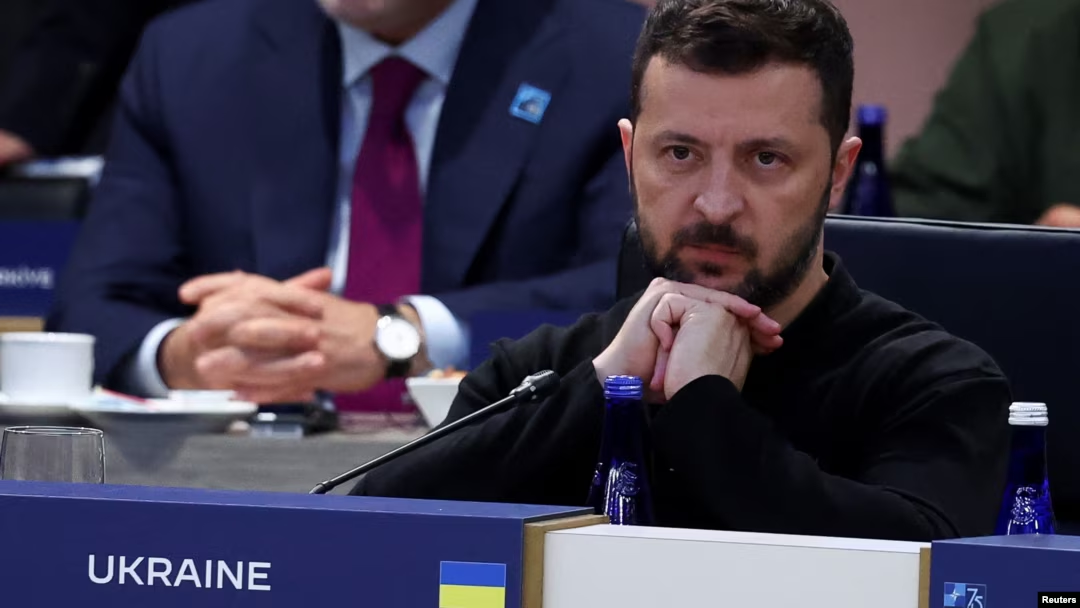
Trump’s Dangerous Rhetoric on Ukraine Undermines Sovereignty and Global Security

Donald Trump recently suggested that Ukraine “may be Russian someday,” making this claim just days before a pivotal meeting between U.S. officials and Ukrainian President Volodymyr Zelenskyy. In a televised interview with Fox News, Trump hinted at potential negotiations that could result in Ukraine conceding territory to Russia, which is alarming to many who fear that such an outcome would undermine the Ukrainian sovereignty and embolden Moscow’s aggressive expansionism.

During the interview, Trump expressed that the conflict could potentially end with a ceasefire, but underscored his belief that any future U.S. military aid to Ukraine should be tied to access to its valuable natural resources, particularly its rare earth minerals. He disparagingly framed this reliance on Ukrainian resources as a means for the U.S. to recoup its financial investments in Ukraine, totaling over $65 billion since the start of the conflict.

Trump’s remarks echo a concerning transactional mindset that diminishes the longstanding principles of international aid and alliances, instead commodifying support based on economic gain. His comments suggest a willingness to prioritize profitability over the fundamental support for a nation under siege, a dangerous precedent that could undermine U.S. foreign policy and the integrity of NATO alliances.

In contrast, President Zelenskyy has reiterated that while he seeks a partnership with the U.S., he is not willing to concede Ukraine’s sovereignty or its wealth without the assurance of security guarantees such as NATO membership. This stance reflects a commitment to resist Russian occupation and maintain the integrity of Ukraine’s territorial rights, highlighting the stark difference between U.S. diplomatic priorities under the Trump administration and the current Ukrainian leadership.

The implications of Trump’s rhetoric extend beyond mere political bluster; they chart a troubling course that could embolden authoritarian regimes and destabilize global security. By suggesting that Ukraine’s territorial integrity is negotiable based on its natural resources, Trump not only disrespects Ukrainian sovereignty but also risks facilitating a future that favors Russian expansionism and undermines democratic values worldwide.

(h/t: https://www.cbsnews.com/news/trump-ukraine-russia-war-rare-earth-minerals-zelenskyy-vance-meeting/)

PBS Closes DEI Office Under Trump Pressure Threatening Media Diversity

PBS has shut down its Diversity, Equity, and Inclusion (DEI) office in direct response to a recent executive order from Donald Trump. This closure affects staff members who worked in the DEI unit, previously led by Cecilia Loving. In a statement, PBS vowed to continue reflecting America’s diversity in its workforce despite this setback.

This decision follows a series of Trump’s executive orders designed to dismantle DEI programs across both federal entities and private organizations. PBS is currently under scrutiny from the Federal Communications Commission (FCC), which is investigating potential violations regarding sponsorship disclosures. This inquiry has been instigated by Trump-appointed FCC Chair Brendan Carr, who has repeatedly targeted public broadcasters like PBS and NPR.

Before this closure, PBS had been actively expanding its DEI initiatives, having established a dedicated DEI office in 2022. Their recent reports indicated a record high of 44 percent BIPOC representation in their workforce. However, with the Trump administration’s aggressive stance against DEI efforts, PBS now faces significant challenges in continuing these programs.

The closure of the DEI office represents a worrying trend of undermining efforts to foster diversity and equality in public institutions, echoing broader Republican agendas aimed at eroding inclusive practices. As public broadcasting faces external pressures, the rollback of such initiatives serves to reinforce the exclusionary tactics of Trump and his allies, who are determined to reshape America’s media landscape.

This move not only affects the staff involved but also threatens the integrity of public broadcasting as a space for diversity in representation and perspective. Trump’s regime continues to implement authoritarian tactics aimed at stifling dissent and manipulating media narratives, reminiscent of the strategies employed by populist leaders around the world.

Vance’s Dangerous Claims Undermine Democracy and Judicial Authority in Trump’s Agenda

Vice President JD Vance has made a troubling declaration asserting that judges lack the authority to restrict what he describes as the “legitimate power” of the executive branch, specifically in context to Donald Trump’s agenda. His comments arise amidst multiple court rulings that have recently halted various actions initiated by the Trump administration. These include controversial policies such as the elimination of birthright citizenship and the reassignment of transgender female inmates into male prisons.

Vance’s remarks signal a dangerous trend where the Republican Party seeks to undermine the judiciary’s role as a check on executive overreach. The vice president, who has a legal background from Yale Law School, has positioned himself alongside Trump and other allies in promoting the idea that the president is above the law, especially when it comes to implementing an authoritarian agenda. His statements hint at a willingness to disregard judicial rulings that threaten their interests.

This latest assertion reflects a broader Republican contempt for democratic norms and the essential function of the judiciary in maintaining a balanced government. By championing the idea that judicial decisions can be ignored, Vance and Trump are essentially advocating for an autocratic style of governance, reminiscent of regimes that sideline judicial authority to pursue their radical agendas.

Notably, Trump’s rhetoric continues to escalate, as he condemned a recent court ruling that restricts access to sensitive government payment systems controlled by his administration. This defiance showcases a deliberate strategy by Trump and his supporters to position themselves as victims of judicial oppression, while simultaneously seeking to dismantle the checks and balances that uphold American democracy.

The implications of Vance’s statements are stark; they suggest an increasing likelihood of the Trump administration challenging court orders that it deems unfavorable. This pattern reflects not only an erosion of judicial authority but also a coordinated effort among Republicans to secure fascist control over American institutions, threatening the democratic foundations that have historically restrained presidential power.

(h/t: https://www.nytimes.com/2025/02/09/us/politics/vance-trump-federal-courts-executive-order.html)

Trump’s Loyalty Tests Corrupt National Security Hiring and Threaten Democracy

Donald Trump is imposing loyalty tests on candidates for top national security and law enforcement positions within his administration. These tests often revolve around two critical events: the false claims surrounding the 2020 election results and the January 6 Capitol attack. Candidates have been asked to affirm unsubstantiated narratives, such as whether January 6 was an “inside job” or if the election was “stolen.” Those who refuse to validate these fabrications find themselves sidelined in the hiring process.

Former officials seeking positions in Trump’s administration reported being pressured to conform to these expectations, effectively requiring them to abandon their integrity. Even under normal circumstances, political alignment with the administration is standard practice; however, demanding a specific loyalty regarding false claims erodes the fundamental objectivity that national security roles require. Intelligence professionals must provide accurate assessments, unclouded by partisan preferences, a principle undermined by Trump’s authoritarian policies.

The implications of this loyalty purge extend to the inner workings of the FBI and intelligence agencies, where extensive vetting processes now scrutinize candidates’ past political statements and affiliations. Reports indicate that even seasoned agents have been thrust into uncomfortable positions, with inquiries targeting their views on the Capitol insurrection and the legitimacy of the election. Their fates have become entangled in a politically charged atmosphere, turning traditional roles into partisan battlegrounds.

Dissent against these loyalty tests has emerged within the ranks of former intelligence officials, emphasizing that adherence to truth is paramount for effective governance. Some observers draw parallels with historical instances of purges related to loyalty during political upheaval, such as the McCarthy era. Trump’s pursuit of loyalty to a personal agenda within the intelligence community marks a dangerous precedent, reminiscent of the Nixon administration’s attempts to manipulate federal agencies for personal gain.

The overarching goal appears clear: to reshape federal agencies to align with Trump’s vision, disregarding established norms and ethical conduct. This strategy of using political loyalty as a litmus test threatens not only the integrity of U.S. intelligence but also the very fabric of democratic governance. As Trump continues his quest for power, the erosion of nonpartisan intelligence oversight poses significant risks to national security and the rule of law.

(h/t: https://www.washingtonpost.com/national-security/2025/02/08/trump-administration-job-candidates-loyalty-screening/)

1 19 20 21 22 23 185